Plans sized to the person
Officers or clerks set a schedule, a minimum, and optional AutoPay. Departments can allow partial payments. Each payment updates the balance immediately.
Need to pay a fine, fee, or bill? Use the link on your notice or your agency’s website.
Information for people making a payment
GovPayPlan collects supervision, program, monitoring, and testing fees for probation and community supervision departments. These fees are small, frequent, and often paid by people who do not have a bank account. The minimum fee is $2.00. Reminders are sent by text before each due date. Clients pay with Cash App or a card, and officers take payments in the field on a wireless terminal. The client record shows the balance and the last payment.
Officers or clerks set a schedule, a minimum, and optional AutoPay. Departments can allow partial payments. Each payment updates the balance immediately.
Reminders with a payment link are sent by text and email before each installment and again if it is missed. The department sets the schedule.
Clients pay with Cash App, Apple Pay, Google Pay, or a card from a phone. At the office, a Cashier user records cash and money orders. No processing fee applies to cash.
Wireless terminals for home visits, satellite offices, and reporting days. Pricing is $480 per year or $45 per month. Departments processing $1,000,000 or more per year receive one at no charge.
The client record shows the outstanding balance, the plan, the last payment, and the receipt history. A printed history is available for a hearing.
Reports by date, payment type, and status show which clients are current and which are behind, with the amount and the number of days past due.
These examples are generic. None describes a specific customer.
An officer takes a payment on a mobile terminal during a home visit. The receipt is sent by text, and the balance in the client record updates immediately.
A client receives a text reminder with a payment link the day before an installment is due and pays from a phone with Cash App or a card. The payment posts to the plan.
Before a hearing, the officer prints the client payment history. It lists each installment with its date, method, and receipt number.
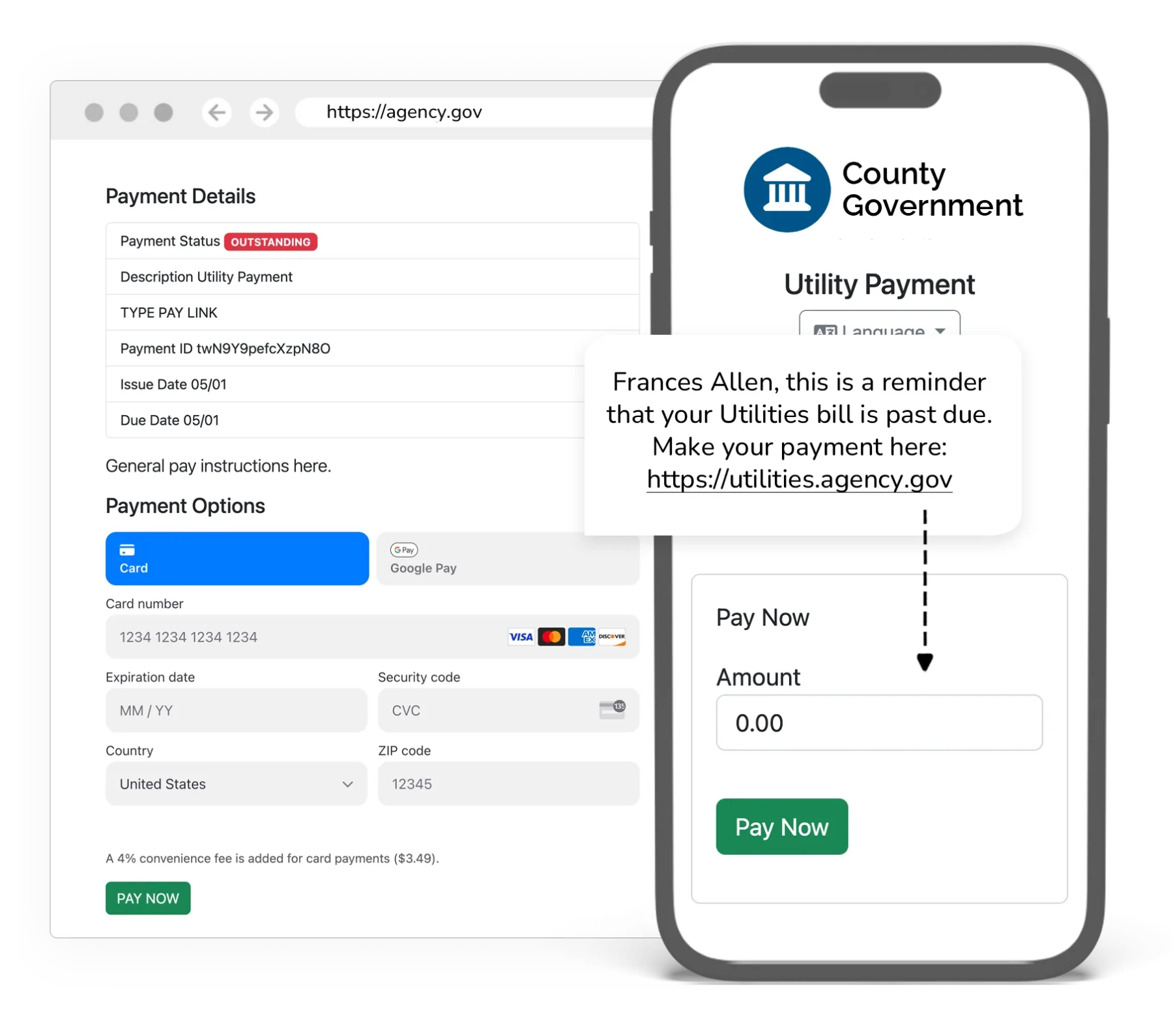
Processing fees are paid by the payer and the agency receives the full amount owed. Rates, minimum fees, the one-year term, and terminal pricing are on the pricing page.
The department settles to one registered bank account. If restitution must settle separately from supervision fees, the two run as separate agency accounts under the county’s organization, each with its own payouts and reports.
Yes. The processing fee on each charge is the percentage rate or the minimum fee, $2.00 for card and wallet and $1.00 for bank, whichever is greater. It is never both, and nothing is added on top of the percentage. A $100 card payment on the Preferred Plan carries a $4.00 fee. A $15 card payment carries a $2.00 fee, because 4% would be only $0.60. Minimum fees reflect the fixed per-transaction costs charged by the payment networks, and ours are about half the small-payment minimums common in the industry.
Yes, where the agency allows it for that payment type. The balance updates as each payment posts, and each payment is subject to the minimum fee.
Two models cover most agencies. The standalone countertop terminal for staffed payment windows is $720 one-time, or $30 per month to rent with a 3-month minimum. The mobile wireless terminal for field use, probation visits, court events, and mobile collections is $480 per year, or $45 per month to rent with a 3-month minimum, with advance replacement included. Every terminal ships fully configured: encryption keys injected, software loaded, and cables or charger included.